
PEB Warehouse: Layout, Spans, Heights… How to Choose Correctly
PEB Warehouse: Layout, Spans, Heights… How to Choose Correctly ensures optimal functionality, cost-efficiency, and scalability for modern storage and logistics operations.

Proper selection transforms warehouses into efficient hubs that support growing inventories and streamlined workflows. PEB Warehouse: Layout, Spans, Heights… How to Choose Correctly balances structural capabilities with operational demands for long-term success.
Defining Warehouse Requirements: Storage, Racking, and Operations Flow
PEB Warehouse: Layout, Spans, Heights… How to Choose Correctly starts by defining precise warehouse requirements based on storage volume, racking systems, and operational flow to avoid underutilized or cramped spaces.

Storage needs dictate floor load capacities—pallet racking for 5-10 tonnes/sqm suits bulk goods, while selective racks handle 1-2 tonnes/pallet for SKUs, requiring column-free zones via tapered beams.
Operations flow maps forklift aisles (min 3.5-4m wide for counterbalance trucks, 2.5m for reach trucks) and picking paths, optimizing ABC analysis layouts with high-density zones centrally.
Racking types influence design: drive-in racks maximize 80% selectivity for FIFO perishables, push-back for 60% density in high-turnover, demanding eave heights of 10-15m for 6-8 levels. Mezzanine considerations add 20-30% floor space without height increases, supported by secondary beams. In PEB Warehouse: Layout, Spans, Heights… How to Choose Correctly, throughput metrics (picks/hour) guide bay sizing—20x10m modules for 50-100 pallets/day.
Safety integrates fire separation (2hr walls every 40m per NFPA), aisle lighting at 200 lux, and dock sequencing to prevent congestion. Software like AutoCAD or Revit simulates flows, quantifying dwell times. Future-proof by allocating 20% extra sqm for e-commerce surges.
read: What Are Pre-Engineered Buildings (PEB)? Benefits, Costs & Applications
Choosing the Right Span: Clear Span vs Multi-Span
PEB Warehouse: Layout, Spans, Heights… How to Choose Correctly hinges on span selection—clear span (20-50m without interior columns) ideal for racking flexibility, enabling uniform storage grids versus multi-span (6-12m bays with columns) suiting budget-tight, low-height ops.
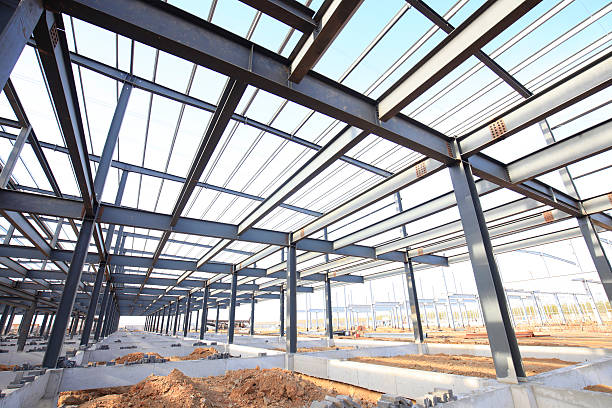
Clear spans use rigid frames or trusses, costing 20-30% more but yielding 15-25% higher storage via no obstructions—perfect for automated AS/RS systems needing 40m+ runs.
Multi-span employs portal frames with purlins, economical for uniform low-rack storage (under 6m high), reducing steel by 40% through closer columns.
Bay widths optimize forklift turns: 6m for VNA, 9m standard. In PEB Warehouse: Layout, Spans, Heights… How to Choose Correctly, wind-exposed sites favor clear spans with tapered rafters minimizing sway (H/400 deflection).
Hybrid options like lean-to on walls cut costs 15% for expansions. Lifecycle favors clear: 10% higher upfront, 20% faster throughput. Select per SKU velocity—high-density picks demand clear.
Height Planning: Clear Height, Mezzanine Options, and Future Expansion
PEB Warehouse: Layout, Spans, Heights… How to Choose Correctly demands strategic height planning, targeting eave clear heights of 8-12m for standard pallets (1.2m x 1m), allowing 7-10 rack levels plus 1m clearance.

Taller 15-20m suits vertical lift modules or cranes, but escalates wind bracing 25% per ASCE 7 exposure C factors.
Mezzanine options—structural steel platforms at 4-6m—double usable space cost-effectively ($200-300/sqm vs $400 new slab), with stair/elevator access and independent HVAC. Composite decks handle 5kN/sqm live loads. Future expansion provisions include oversized footings (20% extra), bolt patterns for roof raises, and modular end bays for 50% length extensions without demo.
In PEB Warehouse: Layout, Spans, Heights… How to Choose Correctly, crane runway heights add 2-4m, girder depths 1-1.5m for 5-20 tonne lifts. Snow zones up eave 10% for pitch. Peak heights (eave + rise) optimize drainage (1:20 min slope).
read: Excellence in Steel Structures and Pre-Engineered Buildings
Loading Zones & Doors: Docks, Shutters, and Truck Circulation
PEB Warehouse: Layout, Spans, Heights… How to Choose Correctly optimizes loading zones with dock high doors (1.2×2.4m) at 1.1m height for 40ft trailers, including levelers, seals, and shelters to cut energy loss 30%.
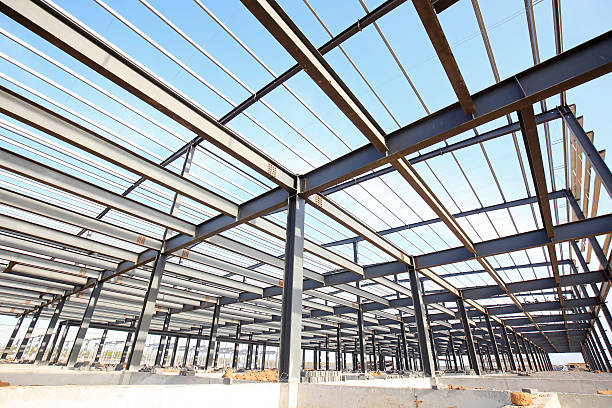
Dock ratios: 1 per 1000-2000sqm turnover, angled for U-turns (min 20m turning radius for semis).
Shutters/rollup doors (4x4m) suit low-volume pedestrian/truck access, high-speed for traffic (open/close 10s). Truck circulation mandates one-way loops (6m lanes), turning bays (18m dia), and marshalling pads for 4-6 trailers. Perimeter docks minimize internal travel.
In PEB Warehouse: Layout, Spans, Heights… How to Choose Correctly, canopy overhangs (2-3m) protect ops rain-free. LED dock lights (500 lux) and bollards prevent collisions. Codes require 2hr fire doors every 60m.
Ventilation, Lighting, and Insulation for Efficient Warehouses
PEB Warehouse: Layout, Spans, Heights… How to Choose Correctly incorporates ventilation via turbo vents (1/1000 roof area) and wall louvers (1/20 under eaves) for 20 air changes/hour, preventing condensation in humid climates. EVAP coolers or roof exhausts maintain 24-28°C for perishables.

Lighting targets 300-500 lux via LED high-bays (150lm/W, motion sensors), zoned for racks/docks with 0-10V dimming saving 40% energy. Insulation—polyurethane panels (50-100mm, R-20-40)—halves HVAC loads, with vapor barriers for cold storage (R-40+).
In PEB Warehouse: Layout, Spans, Heights… How to Choose Correctly, skylights (20% roof) provide daylight factor 5%, reducing artificial by 30%. Smoke vents double as ventilation. Smart controls integrate CO2 sensors.
PEB Warehouse: Layout, Spans, Heights… How to Choose Correctly delivers peak efficiency through integrated planning. PEB Warehouse: Layout, Spans, Heights… How to Choose Correctly future-proofs operations for decades.
Frequently Asked Questions (FAQ)
How to define requirements in PEB Warehouse: Layout, Spans, Heights… How to Choose Correctly?
Map storage volumes, rack loads, aisle widths, and throughput for optimal flow.
Clear span or multi-span for PEB Warehouse: Layout, Spans, Heights… How to Choose Correctly?
Clear for flexibility/high-density; multi for cost on low-rack storage.
Ideal heights in PEB Warehouse: Layout, Spans, Heights… How to Choose Correctly?
8-12m eave for pallets; add mezzanines and expansion provisions.
Docks per sqm in PEB Warehouse: Layout, Spans, Heights… How to Choose Correctly?
1 dock/1000-2000sqm, with levelers and circulation loops.
Ventilation needs for PEB Warehouse: Layout, Spans, Heights… How to Choose Correctly?
20 ACH via vents/insulation; LEDs at 400 lux for efficiency.