
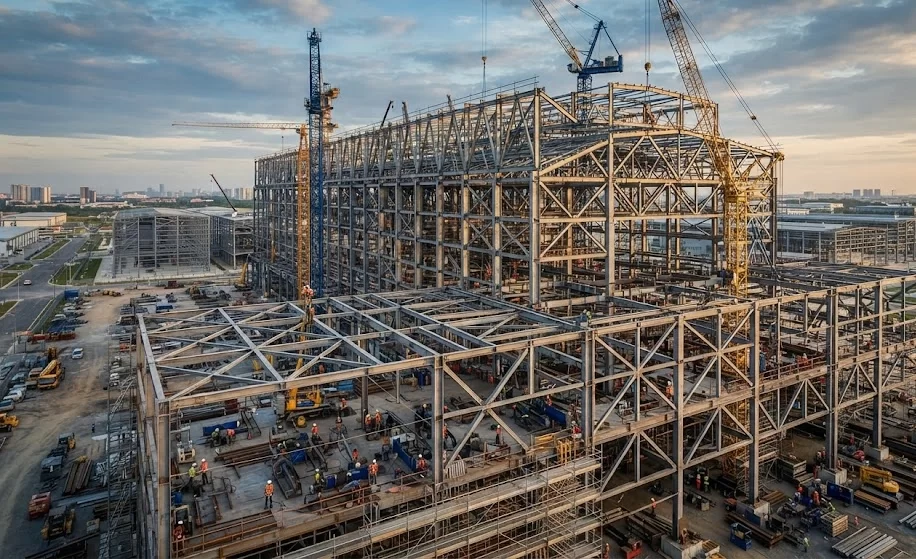
Whether constructing manufacturing facilities, logistics centers, aircraft hangars, shopping complexes, or multi-purpose warehouses, steel provides unmatched structural performance while significantly reducing construction timelines. Unlike conventional building methods that rely heavily on concrete and masonry, steel construction offers precision engineering, efficient fabrication, and rapid on-site assembly.
Today’s competitive markets require buildings that can easily adapt to changing operational needs. Companies often expand production lines, install new machinery, or modify internal layouts. Steel Structures make these adjustments easier because their modular design allows future expansion without major structural modifications.
This growing popularity is not simply a trend—it reflects a fundamental shift toward smarter, more sustainable construction practices that prioritize efficiency without compromising safety or quality.
Understanding Steel Structures
Steel Structures are engineered frameworks made primarily from structural steel members that safely transfer building loads to the foundation. Every component is carefully designed using engineering software to ensure maximum performance while minimizing unnecessary material usage.
A typical steel building includes several interconnected elements:
- Steel columns
- Main beams
- Roof rafters
- Secondary framing
- Bracing systems
- Connection plates
- Bolts and welds
Each component performs a specific function, creating a complete structural system capable of resisting gravity loads, wind forces, seismic activity, and operational stresses throughout the building’s service life.
Because structural steel is manufactured under controlled factory conditions, every piece meets strict dimensional tolerances before arriving at the construction site. This level of precision greatly simplifies installation and improves the overall quality of the finished building.
Steel Structures: The Foundation of Modern Construction for Strength, Speed, and Sustainability
Why Businesses Prefer Steel Structures
1. Reduced Project Timelines
Time is one of the most valuable resources in construction. Every week saved during construction allows businesses to begin operations earlier and generate revenue sooner.
Steel Structures accelerate project completion because fabrication and foundation work can occur simultaneously. While site preparation continues, structural components are manufactured off-site. Once foundations are complete, installation proceeds quickly using cranes and skilled erection crews.
Compared with conventional reinforced concrete construction, steel projects often reduce completion schedules by several weeks or even months.
2. Lower Lifecycle Costs
Although some people focus only on initial construction expenses, experienced developers evaluate the total lifecycle cost of a building.
Steel Structures often provide significant financial advantages through:
- Reduced maintenance requirements
- Longer service life
- Faster construction
- Lower labor costs
- Reduced foundation expenses
- Easier renovations
- Higher resale value
Over several decades, these benefits frequently outweigh differences in initial construction costs.
3. Outstanding Structural Performance
Steel possesses exceptional mechanical properties that allow engineers to design lighter yet stronger buildings.
Its high strength-to-weight ratio enables longer roof spans without excessive structural depth. This characteristic is particularly valuable in facilities where uninterrupted floor space improves productivity.
Warehouses, factories, sports arenas, and logistics centers all benefit from wide clear-span designs made possible through Steel Structures.
Adaptability for Future Growth
Modern businesses rarely remain the same size throughout their lifespan. Production increases, storage requirements expand, and technological upgrades become necessary.
Traditional buildings often require expensive demolition and reconstruction when expansion becomes necessary.
Steel Structures offer a much more practical solution.
Additional building sections can frequently be integrated into the original design with minimal interruption to daily operations. Roof extensions, mezzanine floors, crane systems, and additional bays can all be incorporated efficiently when future expansion has been considered during the initial engineering phase.
This flexibility protects the owner’s investment while supporting long-term business growth.
read also:Best Industrial Shed Designs Inspired by Kirby Building Systems
Precision Engineering Makes the Difference
One of the defining characteristics of Steel Structures is the precision involved in their design and fabrication.
Modern engineering software performs advanced structural analysis before manufacturing begins. Engineers evaluate:
- Dead loads
- Live loads
- Wind pressure
- Earthquake resistance
- Thermal expansion
- Crane loads
- Snow loads where applicable
Every connection, weld, and bolt arrangement is carefully calculated to satisfy international engineering standards.
Once approved, computer-controlled fabrication equipment cuts, drills, welds, and prepares each steel member with remarkable accuracy.
The result is a structure that assembles efficiently on-site while maintaining exceptional structural integrity.
Fire Protection and Safety
A common misconception is that steel buildings are unsafe during fires. In reality, modern Steel Structures incorporate comprehensive fire protection strategies that comply with international building regulations.
Protective methods include:
- Fire-resistant coatings
- Intumescent paint systems
- Fire-rated cladding
- Concrete encasement where required
- Automatic sprinkler systems
- Fire compartment design
Combined with professional engineering, these measures provide buildings that satisfy strict safety requirements while maintaining structural reliability.
Steel Structures Support Sustainable Construction
Environmental responsibility has become one of the most important considerations in modern building design.
Steel is among the most recycled construction materials in the world. Structural steel can be reused multiple times without losing its mechanical properties, reducing the demand for new raw materials and minimizing construction waste.
Factory-based fabrication also improves material efficiency by optimizing cutting patterns and reducing scrap. Since steel components are manufactured to exact dimensions, less waste is generated compared to traditional on-site construction methods.
In addition, lighter structural systems often require smaller foundations, reducing concrete consumption and lowering the overall environmental impact of the project.